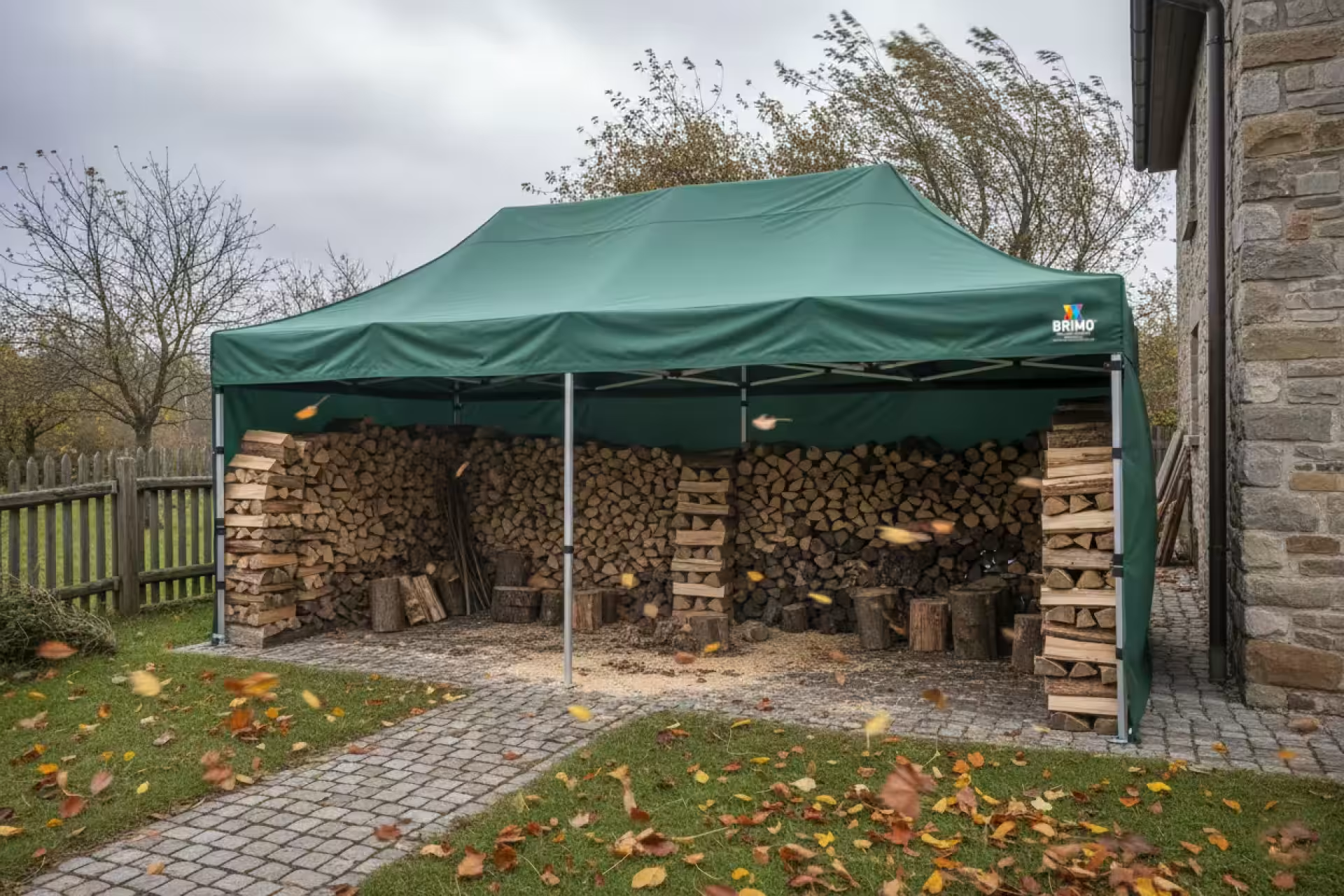
Why your firewood needs more than just a tarp: The pop-up garden gazebo as a winter hero
With the arrival of the cold months, the attention of every fireplace or stove owner turns to one key commodity – firewood. Many people make the fundamental mistake of thinking it is enough to just "cover" the wood with something. However, using impermeable plastic tarps directly on the wood often leads to mould formation and rot, because moisture has nowhere to escape. Proper storage is not just a question of aesthetics, but above all of heating economy. Damp wood has up to 50% lower calorific value and clogs the chimney with soot. This is exactly where a modern and flexible solution comes onto the scene – the pop-up garden gazebo.
Airflow and protection: The perfect balance
Unlike static woodsheds, the construction of which requires time, materials and often planning permission, pop-up garden gazebos offer immediate functionality. Their biggest advantage in wood storage is ensuring the chimney effect. The roof of the gazebo protects the wood from direct rain and snow, while the open or only partially closed space allows for constant air circulation. This is the key factor so that the wood not only does not get wet, but continuously dries during the winter and matures to an ideal moisture content of below 20%.
Flexibility you will love
Winter is unpredictable and your garden's needs change. You can no longer move a fixed shelter, but a mobile gazebo gives you freedom. Do you need to move the storage closer to the house because half a metre of snow has fallen? Or do you want to use the space in the spring for a BBQ? This variability makes the gazebo an investment that goes beyond mere seasonal fuel storage. It is a multifunctional tool that adapts to your current needs, not the other way around.

Duel of solutions: Why the gazebo wins over the tarp and the woodshed
When deciding on wood storage, homeowners often waver between three options: a cheap cover tarp, building a permanent shelter or using a mobile solution. Each method has its pros and cons, but when it comes to the ratio between price, flexibility and drying quality, the pop-up garden gazebo represents the golden mean. Let's look at a direct comparison of key properties that influence the quality of your fuel.
| Criterion | Pop-up garden gazebo | Ordinary cover tarp | Fixed wooden shelter |
|---|---|---|---|
| Air circulation | ⭐⭐⭐⭐⭐ (Excellent, chimney effect) |
⭐ (Minimal, risk of moulding) |
⭐⭐⭐⭐ (Very good) |
| Implementation speed | Immediate (Set up in 60 s) |
Fast (Depends on tying) |
Slow (Days to weeks of construction) |
| Location flexibility | High (Possibility to move anytime) |
Low (Tied to the wood pile) |
None (Permanent building) |
| Protection against snow | High (Roof with PVC layer) |
Medium (Risk of tearing under snow weight) |
High (Solid roof) |
Material technology: Not every tent is the same
When choosing a gazebo for the winter season, it is important not to think of it as a "party tent" from the supermarket. A high-quality pop-up garden gazebo intended for year-round use features a construction of anodised aluminium or powder-coated steel, which prevents corrosion even in a damp environment.
However, even more important is the roof canvas. Unlike cheap fabrics, professional models use polyester with an internal PVC or PU layer. This material is 100% waterproof and at the same time frost-resistant, so it does not crack in sub-zero temperatures. This ensures that your wood remains dry even when snow melts on the roof, which is a critical moment when ordinary tarps often fail and let water through directly into the centre of the wood pile.
Optimising space under the gazebo
Having a quality roof is only half the battle. To fully utilise the potential of the pop-up gazebo, we recommend not stacking the wood directly on the grass or soil underneath it. Moisture rising from the ground is a silent killer of calorific value. The ideal combination is to set up the gazebo and cover the floor with old pallets. By doing this you create an air tunnel: air circulates under the pallets, passes through the gaps in the wood and moisture escapes through the open sides of the gazebo. This system is often hard to achieve in a closed woodshed without installing additional ventilation grilles.

An investment that pays you back in the warmth of your home
Preparing firewood for winter is not just about chopping and stacking it. It is a strategic game with moisture and time. As we have shown, the pop-up garden gazebo represents a strong ally in this game. It is not just about a more aesthetic solution compared to shapeless tarps, but above all a functional tool, which ensures that the energy you invested in the wood (whether by buying or working) is not wasted due to rot and moisture. Dry wood means a cleaner chimney, higher heating efficiency and ultimately lower heating costs. When the snow melts in the spring, you simply fold up the gazebo or turn it into the centre of garden parties.
Additional questions from practice
1. How do I anchor the gazebo in winter when the ground is frozen and I can't use pegs?
This is a frequent problem that has a simple solution. If the ground is too hard to drive steel nails into,
rely on weight bags filled with sand or gravel, which attach to the gazebo legs.
An alternative is cast iron weights. In the winter period, when there is a risk of stronger gusty wind, we recommend loading each leg
with a minimum weight of 15 – 20 kg. By doing this you ensure the stability of the structure even without intervening in the frozen terrain.
2. Should I put all four side walls on the gazebo so it doesn't snow on the wood?
Definitely not. Although it is tempting to "close" the wood in safety, hermetically closing the space would stop air circulation
and create a greenhouse effect, which would lead to moulding. We recommend using side walls on a maximum of two sides –
those from which the wind blows most often and rain or snow falls (usually the west side). Leave the remaining sides open.
If you want to increase protection, use only half walls, which protect the wood from below, but leave the top free for ventilation.
Prepare for winter smartly. Your wood will thank you by crackling in the fireplace, not by hissing steam.
Written by:
Lukas Takumi
About the author
Lukas Takumi – specialist in innovations and implementation of new technologies in portable structures and tent systems, with more than 10 years of experience in the field of mobile solutions for events and industrial applications.
He studied the implementation of the latest technologies at the University of Tokyo and participates in collaboration with the BRIMO company in designing and verifying innovative tents that guarantee safety, rapid assembly and durability of materials.
His contributions focus on practical advice on the choice, maintenance and safe use of pop-up gazebos and the integration of innovative solutions into daily operation.